
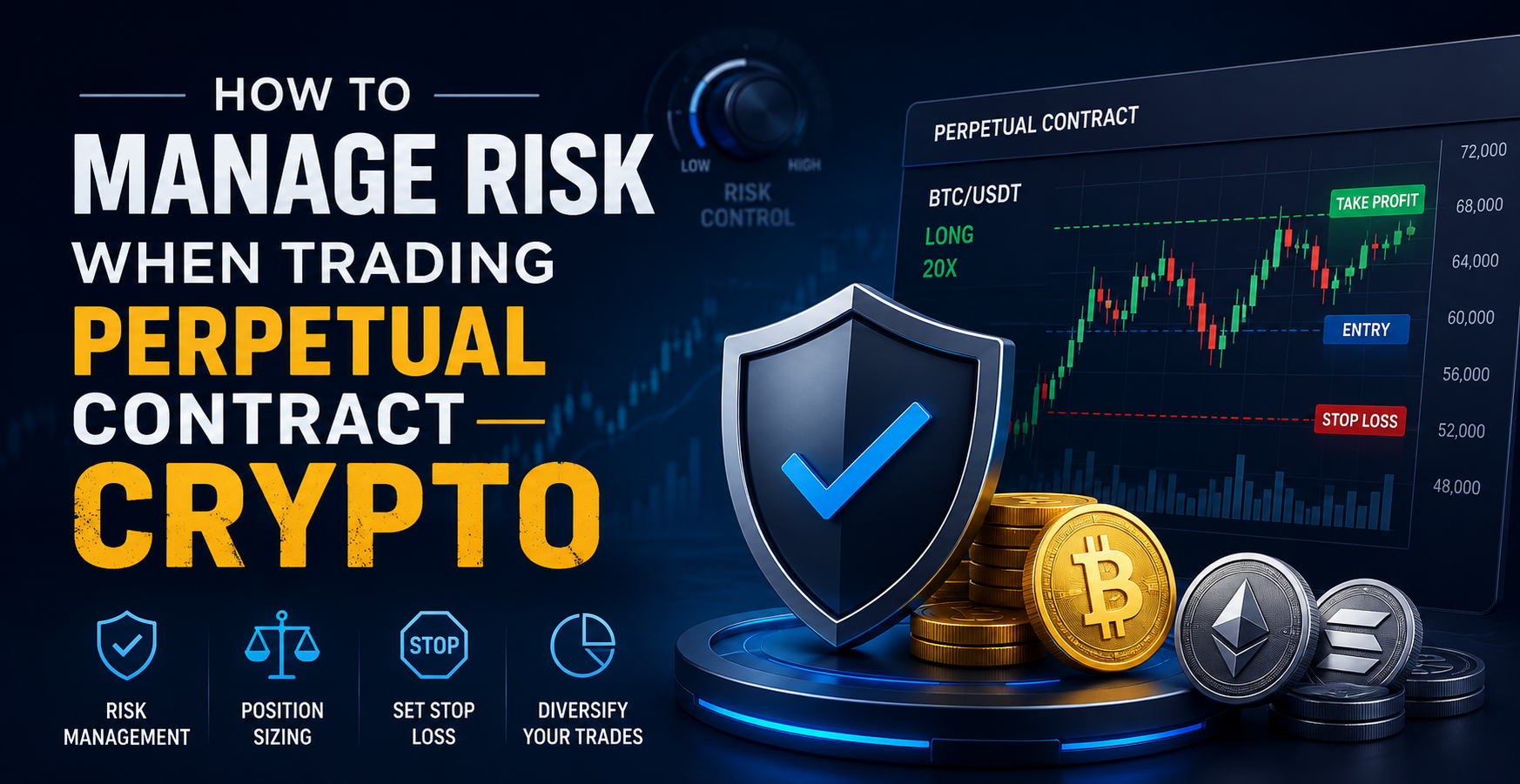

One of the most vital skills you need to develop when trading cryptocurrency using perpetual contracts is risk management. In the case of perpetual contract crypto, there is something known as leverage, which can amplify gains, allowing traders to benefit whether the market goes up or down, but it can also exacerbate losses. Even experienced traders can face serious problems due to a lack of an effective risk management strategy. This article explains how focusing on capital preservation rather than earnings will make it possible for you to improve your trading results.
Here are ways you can manage risk when trading perpetual contract crypto:
Control the Size of Your Position
One of the best ways to reduce your trading risk is to control the size of your position. Large positions are particularly dangerous because of the high volatility of the Bitcoin exchange. To enter into a position in perpetual contract crypto trading, you must determine the proportion of your trading capital you are willing to risk on each trade. Most experienced traders will risk only 1% to 2% of their capital on each trade. Also, position sizing and leverage are interdependent.
Pick the Right Margin Style
Risk management involves making other decisions in addition to determining your risk tolerance. Two types of margin styles exist. The isolated margin and the cross margin are available through most cryptocurrency exchanges. In the case of isolated margins, only the funds set aside for the specific trade are at stake. Your losses will not exceed the set-aside margin if the trade turns against you. Cross margins, on the other hand, involve dividing the available balance across different holdings. Before taking a position in perpetual contract cryptocurrency trading, you should comprehend how each margin style operates.
Stop-loss Implementation
Among the most effective ways to limit losses is a stop-loss order, which prevents emotions from influencing the decision-making process and automatically sells your trade when the price reaches a certain level. Without a stop-loss order, traders might hang on to their losing trades too long, thinking that the market situation will soon improve. Before opening a perpetual contract in crypto, traders need to establish the point at which they need to close the position using technical analysis, support/resistance levels, or the maximum allowable loss. You can check out Flipper to access a platform that will help you make confident decisions every step of the way.
Monitor the Funding Rate
In contrast to regular futures, there is no expiry date with perpetual contract crypto. The funding rate is applied by exchanges to keep the contract price correlated with the spot market. A positive funding rate means that long traders pay short traders, while a negative one means that short traders pay long traders. Monitoring the funding rate helps traders to understand the prevailing sentiment in the market and the cost of trading long-term positions. Very high funding rates might be a sign of crowded positions with a high probability of a strong reversal.
Recognize Auto-Deleveraging and Liquidation
Liquidation will take effect when your account balance does not have sufficient funds to continue to support your leveraged position. ADL can be invoked in the case of drastic changes in the value of the market. The traders who earn profits in such instances find themselves in a situation where some of their positions get auto-reduced since they do not have adequate insurance funds. It becomes easy to speculate on perpetual contract crypto when you have ensured that your margin is sound and not too high.
Conclusion
Being able to identify profitable trends in the market is not enough for a trader to be able to trade effectively in perpetual contract cryptocurrency. It is important to be familiar with how to control the size of their positions, apply appropriate margin modes, have stop-loss orders, check the funding rates, and be conversant with liquidations and auto-deleveraging.