
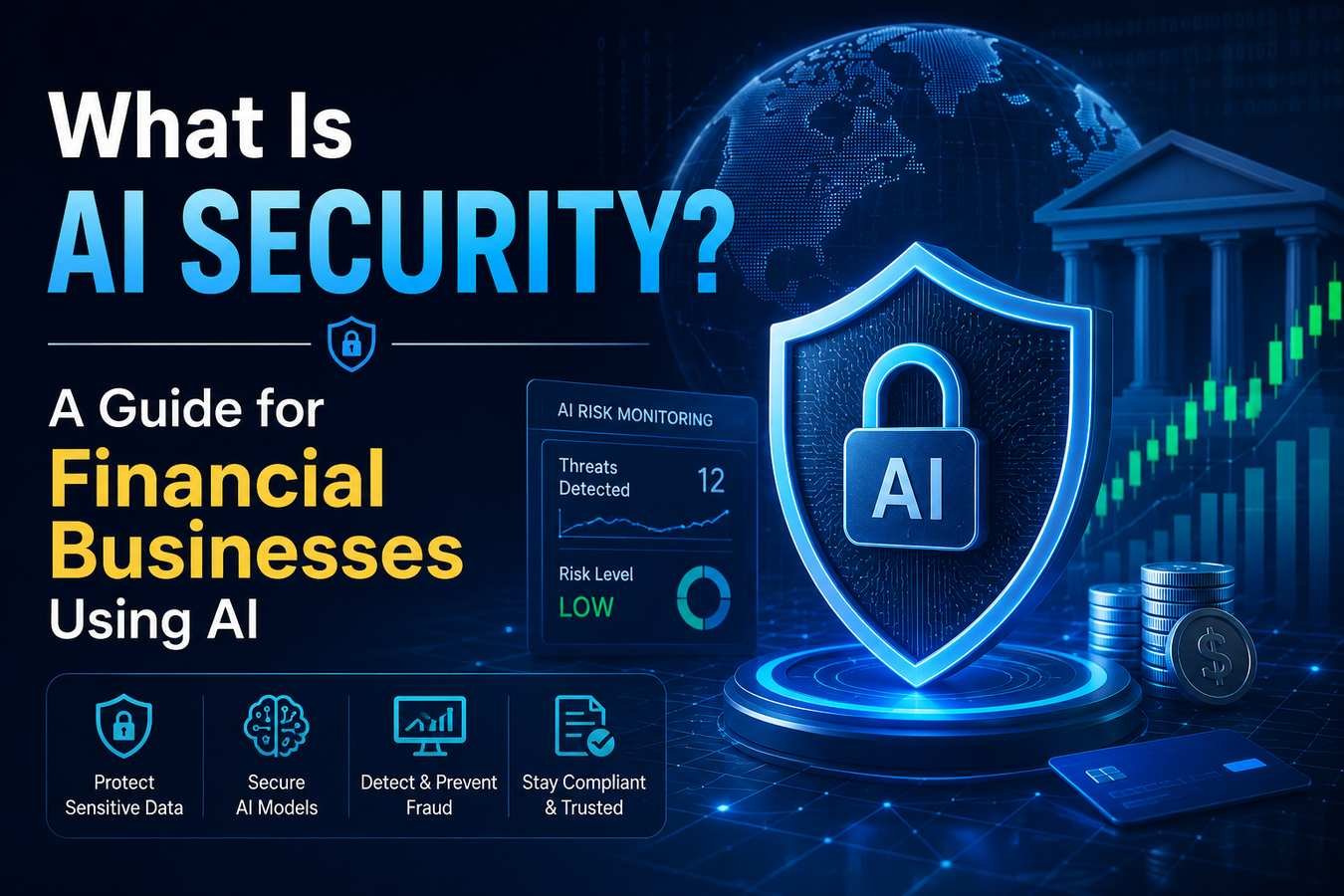

Artificial intelligence now sits inside credit decisions and fraud detection. Also, AI is used in customer support, document processing, and market analysis. Although useful, it also creates unfamiliar exposure.
For financial businesses asking what AI security is, the answer goes beyond protecting software. Then, it is about protecting models, data, and decisions. Also, it is about protecting customers throughout the AI lifecycle.
AI Security Starts With the Threat Model
Traditional cybersecurity focuses heavily on –
- Networks
- Applications
- Identities
- Devices.
Basically, AI security retains those controls while expanding the threat model. The model itself becomes an asset. The same happens with its –
- Training data
- Prompts
- System instructions
- Embeddings
- Outputs
- Automated actions.
So, there are more pieces to monitor. Also, there are more places where something can quietly go wrong.
Also Read : 7 Best AI Tools for Finance in 2026
What AI Security Means for Finance Businesses
A financial AI system may operate correctly from a technical standpoint. However, it might produce unsafe business outcomes. For example, a lending model could remain online and uncompromised. Still, it might rely on distorted data.
Likewise, a chatbot might protect account credentials. However, it might still reveal confidential information through a manipulated prompt. Now, security includes behavior rather than merely uptime.
So, understanding what is AI security gives financial organizations a clearer way to manage these risks before deployment. It encourages teams to examine
- How models reach decisions
- Which data enters the system
- Who can influence outputs
- Where human intervention remains necessary.
Why Financial AI Faces a Different Risk Profile
At the outset, financial institutions already handle –
- Sensitive identities
- Transaction histories
- Income records
- Credit information
- Behavioral signals.
Essentially, AI systems combine and interpret those records at unusual speed. Consequently, one weak control might affect thousands of decisions. This might happen before a conventional review process even notices the pattern.
Nevertheless, the attraction for attackers is fairly obvious. For instance, a manipulated fraud model may approve suspicious payments. Also, a poisoned training dataset may gradually weaken detection rules.
Meanwhile, prompt injection might push an AI assistant to –
- Ignore instructions
- Expose internal material
- Invoke connected tools in ways its designers never intended.
So, it is not exactly a minor software bug.
Moreover, there is another layer. Financial AI might influence –
- Whether someone receives credit
- How a transaction is classified
- Whether an account is investigated.
Therefore, security failures may become conduct, fairness, privacy, or compliance failures. In fact, technical teams cannot manage that overlap alone.
AI Security Versus Conventional Cybersecurity
The distinction matters because familiar controls do not automatically address model-specific behavior. Although firewalls and access controls remain essential, they cannot determine –
- Whether a model has learned an unreliable correlation
- Whether it followed a malicious instruction hidden inside a document.
| Security Area | Conventional Focus | Additional AI Security Focus |
|---|---|---|
| Data protection | Preventing unauthorized access or loss | Detecting poisoned, biased, or unapproved training data |
| Application security | Fixing code vulnerabilities | Testing prompts, model behavior, and output boundaries |
| Identity management | Controlling user and service access | Restricting model access to tools, agents, and financial systems |
| Monitoring | Detecting malware and abnormal traffic | Tracking output drift, unsafe responses, and decision anomalies |
| Incident response | Containing compromised systems | Suspending models, reversing automated actions, and reviewing affected decisions |
The Main AI Security Risks in Finance
With AI in finance, there are multiple security risks. The following are some of the major risks businesses should be aware of:
1. Model Manipulation Deserves Immediate Attention
Attackers may craft inputs that cause an AI system to bypass its rules or disclose protected context. Furthermore, malicious instructions might hide inside –
- Email messages
- Uploaded files
- Websites
- Customer documents that an AI agent later processes.
2. Data Poisoning Creates a Slower, Murkier Problem.
Altered training information might change how a model classifies risk without creating an obvious system failure. In addition, model extraction attacks may enable outsiders to reconstruct valuable model behavior via repeated queries.
Basically, the business loses intellectual property. Meanwhile, attackers gain a map of internal decision logic.
3. Privacy Leakage Remains Equally Serious
Models may reproduce personal or confidential information found in training or retrieval sources. Therefore, businesses exploring what is AI security should treat every model output as a potential disclosure point. This must happen especially when the model can search internal repositories or summarize customer records.
Controls That Financial Businesses Actually Need
At the outset, a sensible control framework starts before model development. In this case, the organization should classify every AI use case by –
- Data sensitivity
- Customer impact
- Autonomy
- Reversibility.
To be honest, a tool that drafts internal meeting notes does not require the same scrutiny as an agent that blocks transactions or recommends credit limits.
So, several controls deserve priority:
- Maintain an inventory of –
- Models
- Datasets
- Prompts
- Owners
- Vendors
- Integrations
- Approved uses.
- While applying least-privilege access, separate the following areas:
- Development
- Testing
- Production environments.
- Test models against –
- Prompt injection
- Data leakage
- Evasion
- Harmful outputs
- Unusual input patterns.
- Require human review for high-impact or difficult-to-reverse financial decisions.
- Without collecting unnecessary personal data, try to log –
- Model inputs
- Outputs
- Tool calls
- Overrides
- Configuration changes.
However, a checklist is not enough. In fact, controls must connect to business consequences. If a fraud model fails, teams should know which payments it influenced.
Meanwhile, if a credit model drifts, reviewers should identify affected applicants. Then, they must reassess decisions. Basically, traceability makes remediation possible. Without it, incident response becomes guesswork.
Vendor Models Do Not Transfer Accountability
Many financial businesses consume AI through cloud platforms, APIs, or embedded software. That arrangement moves infrastructure rather than accountability.
So, procurement teams should examine how vendors –
- Isolate customer data
- Manage retention
- Test models
- Report incidents
- Control subcontractors.
In fact, vague assurances such as “enterprise-grade AI” offer very little protection.
Moreover, contracts should also address model changes. For instance, a vendor may update its underlying model without altering the product name. As a result, output quality, security behavior, or decision consistency may shift overnight.
Therefore, financial businesses need –
- Notification rights
- Testing windows
- Audit evidence
- A practical exit plan.
AI Security Requires Continuous Governance
AI systems change even when their code stays still.
- Customer behavior evolves
- Fraud patterns move
- Source data shifts
- Vendors release new model versions.
Accordingly, security testing cannot end at launch. In those situations, teams need –
- Recurring red-team exercises
- Drift monitoring
- Access reviews
- Output sampling
- Incident simulations.
The Role of Different Teams
Just as importantly, responsibility must remain visible.
- Security teams should test technical resilience.
- Data teams should examine lineage and quality.
- Compliance specialists should assess regulatory exposure.
- Business owners remain accountable for the outcome.
There should be shared work rather than blurred ownership.
Secure AI Means Controlled, Explainable Financial Decisions
The practical answer to “what is AI security” is control across the complete system. It is not a protective layer added after deployment.
So, financial businesses need –
- Secure data
- Constrained models
- Monitored outputs
- Accountable owners
- Recovery procedures that work under pressure.
Ultimately, AI can improve financial operations. However, it does so only when speed does not outrun oversight.