
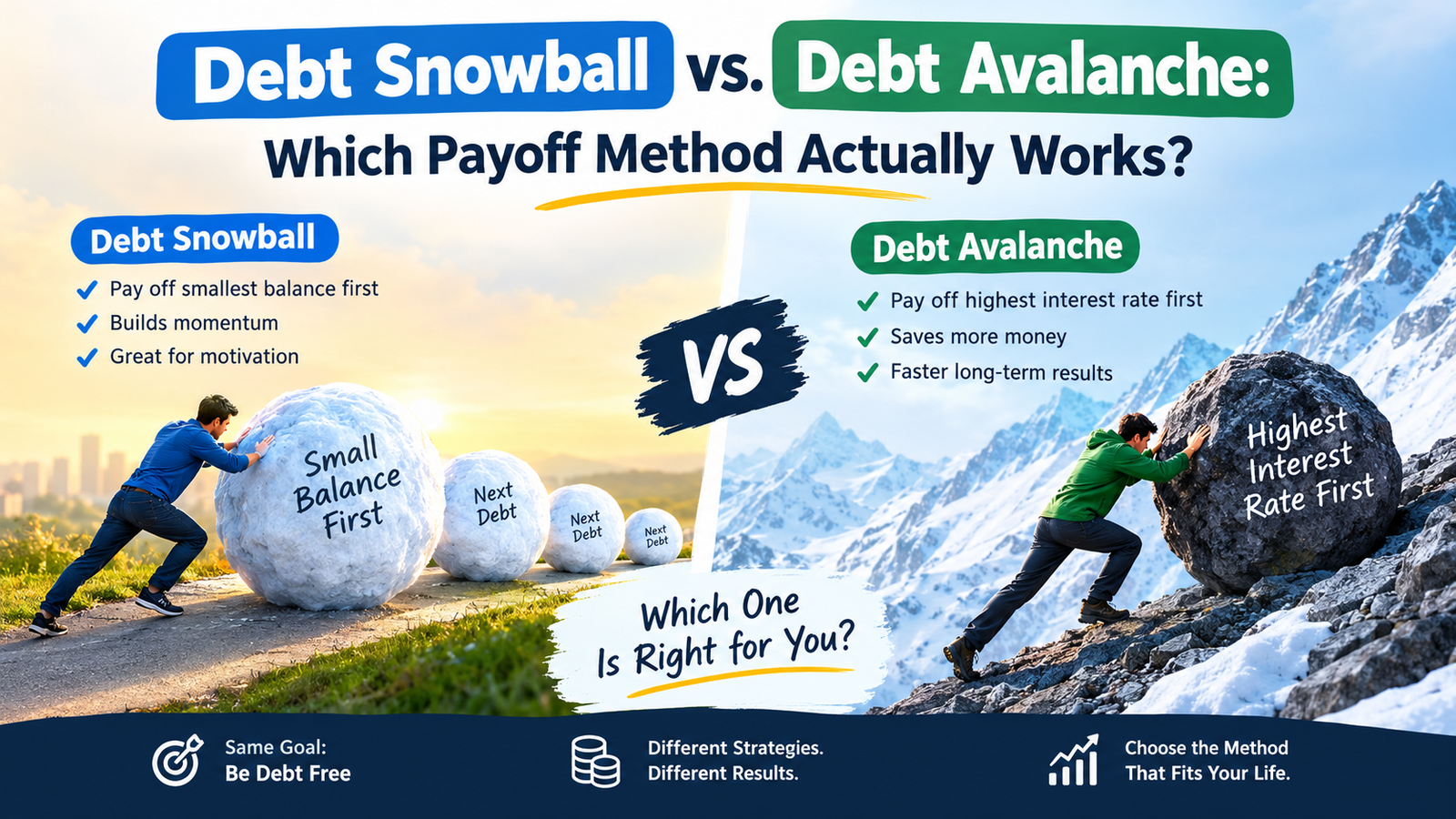

Most people who carry debt do not have a math problem. They have a motivation problem. You can know exactly which balance is costing you the most and still feel stuck, because the number on the screen never seems to move.
That is why two very different payoff strategies have survived for years: the debt snowball and the debt avalanche. One is built around momentum. The other is built around math. Both work, and both fail in the same way when someone quits halfway through.
This guide walks through how each method works, shows you what happens when the same set of debts is paid off both ways, and helps you decide which one fits the way you actually behave with money. We will also cover a middle path that plenty of people end up using without realizing it has a name.
What Is the Debt Snowball Method?
The snowball method says to list your debts from the smallest balance to the largest, ignoring interest rates. You pay the minimum on everything, then throw every spare dollar at the smallest balance until it is gone.
Once that first debt is cleared, you take the money you were paying on it (the minimum plus the extra) and add it to the payment on the next smallest debt. The payment grows with each debt you eliminate, which is where the name comes from. Like a snowball rolling downhill, it picks up size as it goes.
The appeal is psychological. Closing an account feels like a win, and early wins keep people going. If you have ever started a budget and abandoned it three weeks later, this approach is designed with you in mind.
What Is the Debt Avalanche Method?
The avalanche method flips the order. You list your debts by interest rate, highest first, and send all your extra money to the most expensive one. The balance does not matter, only the rate.
Because you attack the costliest debt first, you pay less total interest over time and usually finish a little sooner. On paper, it is the more efficient plan.
The catch is that the highest-rate debt is not always a small one. If it happens to be your largest balance, it can take a year or more before you close a single account, and that long stretch without visible progress is where many people give up.
A Real Example: Same Debts, Two Different Strategies
Numbers make this easier to see, so let’s use a realistic scenario. Imagine someone with three debts and an extra $300 per month beyond their minimum payments.
| Debt | Balance | Interest rate (APR) | Minimum payment |
|---|---|---|---|
| Store card | $1,500 | 14% | $45 |
| Credit card | $5,000 | 24% | $125 |
| Personal loan | $9,000 | 11% | $210 |
Their total monthly budget for debt is $680: the $380 in minimums plus the extra $300. We ran both strategies month by month, charging interest each month and rolling freed-up payments into the next target. These are simplified calculations that assume no new purchases and fixed rates, so treat them as an illustration rather than a quote.
Snowball order: store card, then credit card, then personal loan.
- Store card paid off in month 5
- Credit card paid off in month 18
- Personal loan paid off in month 32
- Total interest paid: about $2,929
Avalanche order: credit card, then store card, then personal loan.
- Credit card paid off in month 14
- Store card paid off in month 17
- Personal loan paid off in month 31
- Total interest paid: about $2,679
So the avalanche saves roughly $250 and finishes one month earlier. That is a real difference, but it is not life-changing. Now look at the other side of the comparison: the snowball gave this person a finished debt in month 5, while the avalanche made them wait until month 14 for the first one.
If waiting nine extra months for a first win would make you lose steam, that $250 saving is worth nothing, because a plan you abandon saves you exactly zero dollars.
How Much Does the Gap Really Matter?
The size of the difference depends almost entirely on how far apart your interest rates are and how large your balances are.
When your rates are close together, say all your debts sit between 15% and 19%, the two methods end up nearly identical in cost. The order barely matters, so you may as well pick the one that feels better.
When one debt has a rate far above the rest, such as a 29% card sitting next to a 6% car loan, the avalanche pulls ahead noticeably, particularly if that expensive balance is big. In that situation, ignoring the rate has a genuine price tag.
In the middle is where most households live: a couple of credit cards, maybe a personal loan, maybe a student loan. The gap there is usually modest, a few hundred dollars over a couple of years, as in our example.
Which Method Is Right for You?
Here is a simple way to think about it.
The snowball tends to suit you if:
- You have tried to pay down debt before and lost motivation
- You have several small balances that could be eliminated quickly
- You respond well to visible progress and checking things off
- The interest rate gap between your debts is small
The avalanche tends to suit you if:
- You are comfortable sticking with a plan even when progress feels slow
- One or two debts carry very high interest rates
- You are motivated by watching the total cost shrink
- Your largest-rate debt also happens to be reasonably sized
Neither list is a test of discipline. It is about knowing yourself. Someone who tracks every expense in a spreadsheet and someone who wants to open the app once a month can both succeed, just with different strategies.
A Hybrid Approach Worth Considering
You are not locked into one pure method. Many people start with the snowball to knock out a tiny balance or two, which gets them moving and frees up some cash flow, then switch to the avalanche for the larger debts.
Another variation is to prioritize by rate unless a small balance is close to being finished. If a card has $180 left, clearing it in a single month is usually worth it regardless of its rate, because it removes a payment and simplifies your life.
The point is to treat these methods as tools instead of rules. If a modified version keeps you consistent, it is the better plan for you.
Step-by-Step: How to Start This Week
1. List every debt. Write down the lender, current balance, interest rate, and minimum payment for each. Include credit cards, personal loans, auto loans, student loans, and any buy-now-pay-later balances. You cannot manage what you have not looked at.
2. Find your extra money. Go through your last two or three months of statements and look for spending that does not match your priorities. Subscriptions you forgot about, bank fees, and small recurring charges add up faster than most people expect. If you want help hunting these down, our guide on how to identify hidden monthly expenses is a good starting point.
3. Choose your method. Use the lists above. If you are torn, default to the one that gets you a quick win, because starting matters more than optimizing.
4. Automate the minimums. Set every debt to autopay its minimum so you never trigger a late fee or damage your credit. Late fees can erase the progress you are working so hard to make.
5. Direct the extra payment to your target debt. Tell your lender the additional amount should go toward the principal. Some lenders apply extra payments to future installments by default, so check how yours handles it.
6. Roll the payment forward. When a debt is cleared, do not let that money disappear into your regular spending. Move the entire payment to the next target immediately. This is the habit that makes both methods work.
7. Review every few months. Interest rates change, income changes, and priorities shift. A quick check-in keeps your plan realistic.
Ways to Speed Things Up
A payoff method decides the order, but a few other moves can shorten the timeline.
- Ask for a lower rate. A call to your card issuer costs nothing. Customers with a solid payment history sometimes get a rate reduction, and even a couple of points off an expensive balance helps.
- Look at a balance transfer carefully. A card with a promotional low or zero rate can pause interest for a while, but transfer fees and the rate after the promotion ends matter. Only consider it if you can realistically pay the balance down during the promotional window.
- Consider debt consolidation, but compare the total cost. Rolling several debts into one loan can simplify payments and may lower your rate. Before you sign, look at the fees, the repayment term, and the total interest. A longer term with a lower payment can cost you more overall. Our walkthrough on finding the best loan type for your needs explains how to compare the options.
- Add income when you can. A one-time sale of unused items, a bit of freelance work, or a tax refund can all go straight to your target debt.
- Stop adding new debt. This sounds obvious, but a payoff plan only works if the balances are actually going down. If new charges keep appearing, you are paying a leaking bucket.
Do You Need an Emergency Fund First?
This is one of the most common questions, and the honest answer is that most people benefit from a small cushion before aggressive debt payoff.
Without any savings, a single car repair or medical bill goes straight onto a credit card, which undoes your progress and can feel discouraging. Many people build a starter buffer, often a few hundred to around a thousand dollars, then attack their debt, and grow the larger fund afterward.
The right amount depends on your income stability, your dependents, and your housing situation. Someone with a variable income or a family relying on them may want more of a cushion than a single person with steady pay.
Common Mistakes to Avoid
Paying only the minimum on everything. Minimums are designed to keep you in debt for a long time. Any extra amount you can add shortens the timeline and cuts interest.
Closing paid-off cards without thinking. Closing an old card can reduce your available credit and shorten your credit history, which may affect your score. Keeping a no-fee card open and using it occasionally for a small purchase you pay off immediately is often the safer choice.
Ignoring the interest rate entirely. Even if you choose the snowball, be aware of any debt with an unusually high rate. If one balance is charging 30%, it may deserve earlier attention.
Giving up after a slip. A bad month happens. An unexpected expense does not erase the progress you have made. Adjust the plan and keep going.
Chasing a perfect plan. The best strategy is the one you will follow for the full 24 or 36 months. A simple plan executed consistently beats a perfect one abandoned in month three.
Frequently Asked Questions
Is the snowball or avalanche method better? The avalanche usually costs less in interest, and the snowball often keeps people more motivated. The better one is the one you will stick with. If your interest rates are close together, the cost difference is small.
Can I switch methods halfway through? Yes. Nothing locks you in. If you started with the avalanche and feel discouraged, switching to the snowball for the smaller balances is perfectly fine, and vice versa.
Does paying off debt improve my credit score? Often, yes, especially when you reduce credit card balances, since that lowers your credit utilization. Payment history matters most, though, so keep every minimum payment on time while you work on the extra payments.
What if I only have one debt? Then the choice is simple. Pay as much extra as you can toward it, and make sure the extra payment goes toward the principal.
Should I consolidate my debts first? It depends on the rate and fees you would get. Consolidation can help when it lowers your overall rate and gives you one manageable payment, but it does not fix the habits that created the debt. Compare the total cost before deciding.
The Bottom Line
The snowball and avalanche methods are two routes to the same destination. The avalanche is the efficient choice on paper, saving $250 in our example. The snowball delivers early wins that keep many people moving, as shown by that first paid-off balance arriving nine months sooner.
If you are unsure, begin with whichever makes you want to open your statements instead of avoid them. Then keep the payment going, roll it forward, and let time do the rest.