


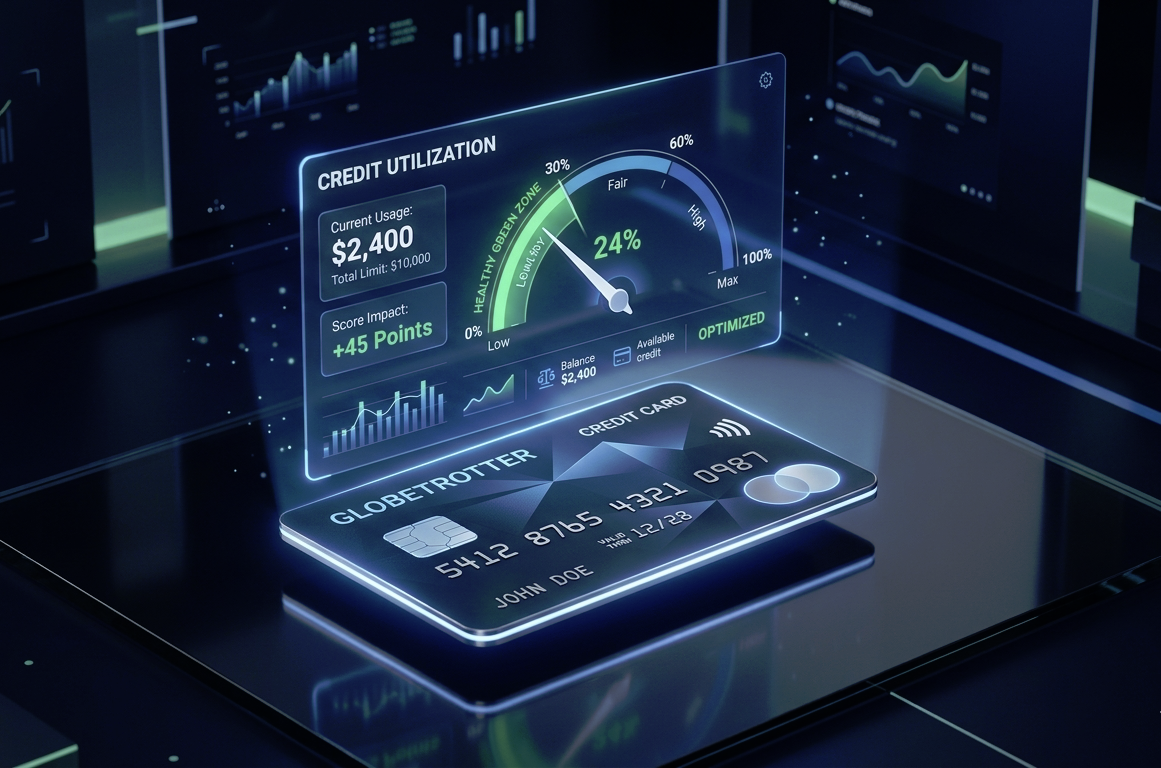
Your credit utilization ratio is the percentage of your total available revolving credit that you are currently using, and it is arguably the most influential factor in your credit score behind your payment history.
If you have a $10,000 limit across your credit cards and your current balances total $3,000, your utilization is 30%. While most conventional wisdom suggests staying under that 30% mark, the reality of 2026 lending is that exceptional scorers with 800+ ratings actually maintain an average utilization closer to 7%.
Lenders view this number as a barometer for financial stress. High utilization suggests you are overextended or relying too heavily on credit to bridge income gaps, whereas low utilization demonstrates you have access to funds but possess the discipline not to exhaust them.
How Credit Bureaus Calculate Your Ratio
There are two primary ways the math works: per-card utilization and aggregate utilization. Per-card utilization looks at each individual account, while aggregate utilization looks at the sum of all your limits versus the sum of all your balances.
If you have one card maxed out at $1,000 and another with a $9,000 limit and a zero balance, your aggregate utilization is 10%, but that first card is at 100%. Scoring models like FICO and VantageScore take both into account. A single maxed-out card can drag your score down even if your total debt seems manageable in the grand scheme of things.
It is also important to understand that these numbers are reported to bureaus based on your statement closing date, not your payment due date. If you spend $2,000 and pay it off in full on the due date, but the statement closes while the balance is still $2,000, the bureau treats that $2,000 as “utilized” credit for that month.
The Shift Toward Trended Data in 2026
We have moved past the era when your credit score was just a static snapshot of your spending from the previous month. Modern scoring models now prioritize “trended data,” which tracks whether your balances are decreasing, staying flat, or “revolving” month-to-month.
Lenders are increasingly interested in whether you are a “transactor” who pays in full every month or a “revolver” who carries a balance. Even if your utilization is low, consistently carrying a balance can signal to some lenders that you are living right at the edge of your means. In the current lending climate, trended data models like FICO 10 T look back at 24 months of behavior to see if you are trending toward debt or away from it.
There are 350 million credit reports updated every day in the United States, and each update now looks for these movement patterns. If you suddenly spike from 10% to 40% utilization, even if you are still within a “safe” range, the sudden trend upward can trigger an alert in automated underwriting systems.
Managing Revolving Credit Limits and Terms
When you are looking to optimize your ratio, you essentially have two levers to pull: you can pay down the debt, or you can increase the available credit limit. Increasing your limit is often the faster route to a better score, provided you don’t immediately fill that new space with more spending.
Accessing the right kind of facility is key to this balance. When exploring your options, using a trusted lender like 118 118 Money can help you understand the nuances of personal credit and how different products impact your overall profile. In the UK market, where these providers operate, the transparency of terms is vital to ensuring that a new line of credit actually serves your goal of lowering utilization rather than becoming a trap for high-interest debt.
Understanding the difference between a revolving facility and a term loan is critical for your score. A personal loan is “installment debt” and does not count toward your utilization ratio the same way a credit card does. Many savvy consumers use personal loans to consolidate credit card debt, effectively moving the balance from a high-impact utilization category to a lower-impact installment category.
Why Your Statement Date Is More Important Than Your Due Date
Most people focus on the due date to avoid late fees, but if you want to manipulate your credit score, you have to master the statement closing date. This is the day the bank cuts the bill and, crucially, the day they report your balance to the credit bureaus.
If you want to report 0% utilization, you must pay your balance before the statement closes, not just before it is due. By paying a few days early, you ensure the bill says $0 when it’s generated. This prevents “phantom debt” from appearing on your credit report.
Effective balance management requires a few specific habits to keep the math in your favor:
- Set up balance alerts that notify you when you cross a 20% threshold on any single card
- Make multiple payments throughout the month rather than waiting for a single lump sum
- Keep old credit cards open, even if you don’t use them, to preserve the “available credit” side of the equation
Business Credit Utilization and 2026 Implications
For entrepreneurs building brands and small business owners running established local companies, credit utilization is a double-edged sword. Business credit cards often don’t report to your personal credit report unless you default, but they heavily influence your business credit score (like the Dun & Bradstreet PAYDEX or Experian Intelliscore).
In 2026, the integration of Open Banking and real-time data sharing means lenders are looking beyond your credit report. They are looking at your actual cash flow. If your business is constantly maxing out its revolving lines of credit, even if you pay them off, a lender might see a “liquidity crunch” rather than a healthy business.
The current trend in the UK and US markets shows that SME utilization remains high at 107% in some sectors, indicating that businesses are relying on credit more than ever. This makes the “available credit” portion of your profile a vital safety net.
The Psychology of Credit Limits
There is a psychological trap in credit utilization: the more credit you are granted, the more you feel you can afford to spend. This is known as “lifestyle creep” in the financial world. High-limit cards are a tool for score optimization, not a license for a higher standard of living.
If you find that having a $20,000 limit makes you spend more than having a $2,000 limit, you are better off keeping the lower limit, even if it hurts your utilization ratio. A slightly lower credit score is far less damaging than a mountain of high-interest debt that you cannot service.
True credit mastery isn’t about avoiding debt entirely; it’s about making the debt look as small as possible to the people watching the numbers. By spreading your spending across multiple cards or securing higher limits that you never touch, you create a buffer that protects your score from the natural fluctuations of monthly expenses.
Mastering the Utilization Game
The path to a perfect credit score isn’t through zero debt, but through the appearance of having massive amounts of credit and choosing not to use it. This signals to the financial world that you are a low-risk, high-discipline borrower.
Monitor your dashboards weekly, understand when your specific lenders report to the bureaus, and never let any card’s balance exceed 30% of its limit. If you can keep that aggregate number under 10%, you are positioning yourself for the best possible rates when it comes time to buy a home or secure a major loan.
Read more on our blog to find deeper insights into navigating the complexities of modern lending and maintaining a robust financial profile, as well as a variety of posts related to small business, investment, and more.